Sunday, July 25, 2010

It looks like rain and it feels like rain...

Except it’s not raining. In the time since my last blog entry, the weather in Mali has changed from the unbearably hot month of May to a decently rain-filled June, to a cool and dry July. The rain arrived early this year; we even had several big rain storms to break the heat in May. Farmers in my village were excited, thinking this was going to be a great year for rain – they were going to get a big harvest! Some began plowing their fields and planting seeds earlier than they might do on a normal basis. At the beginning of June, those who hadn’t yet started planting their crops were considered lazy.

Now, we’re into July. In the last 3 weeks we’ve had 3 rainstorms, only one of which was substantial enough to keep the ground wet for more than an hour. Everyone keeps saying “dugu jalendon” (the ground is dry). Millet and other crops that were planted in June are wilting and being destroyed by insects. I gave 10 farmers new varieties of sorghum to test in their fields (seeds from ICRISAT) 3 weeks ago. Most haven’t been able to plant their seeds yet; some haven’t even been able to plow the area in which they are going to plant the seeds! The ground is too hard and dry to work with. One friend came back from the fields before lunch time today, saying “There’s nothing to do until it rains – the ground is too dry.” Normally, people would be in their fields from morning through afternoon at this time of year.

Granted, this is only my 2nd rainy season in Mali. And last year in training, I had no idea what was going on, or what should be going on. This year, I still don’t know what a normal rain pattern is for the area, but I do know that people in my village seem scared and antsy. Hopefully the rains will return soon and all of this will be moot. I asked one farmer what he would do if the rain didn’t come, his response, “Nothing, it’s God’s will.” I guess there’s not much you can do when you’re entire livelihood is based on rain-fed agriculture and having a successful harvest.

Other than a lack of rain, things have been going well on this side. Even though it hasn’t been raining, clouds are rolling through every day, which drops the temperature to a livable 90-something degrees. We’ve had some beautiful, overcast, Seattle-like days over the last few weeks (except 30-40 degrees warmer.

My brother Ben and sister-in-law Kelly came to visit Mali for a week during June. We had a really good, although very short, visit. We spent a couple of days in Bamako, and spent most of their time at my site. Ben and Kelly were given live chickens on three separate occasions, which were all made into delicious dinners. We visited the fields the day after a big rain (this was before the rain stopped) and saw everyone plowing and preparing their fields for planting. Since both Ben and Kelly are doctors, we visited the health center, so that they could get an idea of what the health issues at my site are. Most of their visit was spent greeting my friends throughout the village; I hope I didn’t tire Ben and Kelly out too much. It was so good to see Ben and Kelly, it meant a lot to have family come to visit and begin to understand a little bit about what Peace Corps is about, and about my experiences in Mali. Thanks Ben and Kelly!

I’ve been working hard in my garden over the last 3 weeks. The early rain in June replenished the ground water to some extent, so I am able to get well water for my garden. I used a daba (hoe) to dig up all the grass that had taken over. This week, I’ve been preparing new beds and planting peppinieres (nurseries). I have a little of everything – peanuts, corn, beans, squash, cucumbers, tomatoes, eggplant, hot peppers, green peppers and a compost pile. I hope it works better than my previous gardening attempts. I harvested a lot of tomatoes, onions, green peppers and lettuce from my last round of planting, but I’ve also had huge problems with insects. I am slowly learning how to deal with all of the problems that come with growing a garden in Mali.

I forgot to comment about the hot season in my last blog entry. I dreaded the month of May starting in February, when the cold season seemed (to me) to end early. It got hot fast. From mid-February onwards it must have been above 100 degrees every day. As late April/May approached, the temperature was 105-110 degrees every day. That’s hot. It got even hotter in other areas of Mali. I think the hottest I experienced was ~115 degrees. When it’s that hot, you drink 7-8 liters of water per day, and learn to follow Malians' examples of showering 3-4 times per day, sitting and doing nothing during the hottest parts of the day, and eating mangoes – 4-6 mangoes per day! The most delicious mangoes you could ever imagine (available in all sorts of varieties) made sticking around through the hot season almost worthwhile. Mangoes may have trumped oranges as my favorite fruit, though it has been over a year since I ate my last delicious orange.

Hope you’re happy and healthy. I’ve been here a year now, and I appreciate all the letters, phone calls, notes, emails and packages that have helped me try to keep in touch with home. Thank you. I’ll leave it at that, here are some pictures for the road:


Watching the World Cup in my village was a pleasure. Until the United States played Ghana, I was able to convince everyone to cheer for the US. Because we don't have electricity more than 3 hours a night, there are very few televisions in town. I watched the games at my language tutor's house. This is a picture from just before the start of the World Cup Final. At one point I counted over 70 people watching the game on the single, small-screen TV.
Some pictures from Ben and Kelly's visit. First, Ben and I on the Niger River:

Kelly and I on the river:

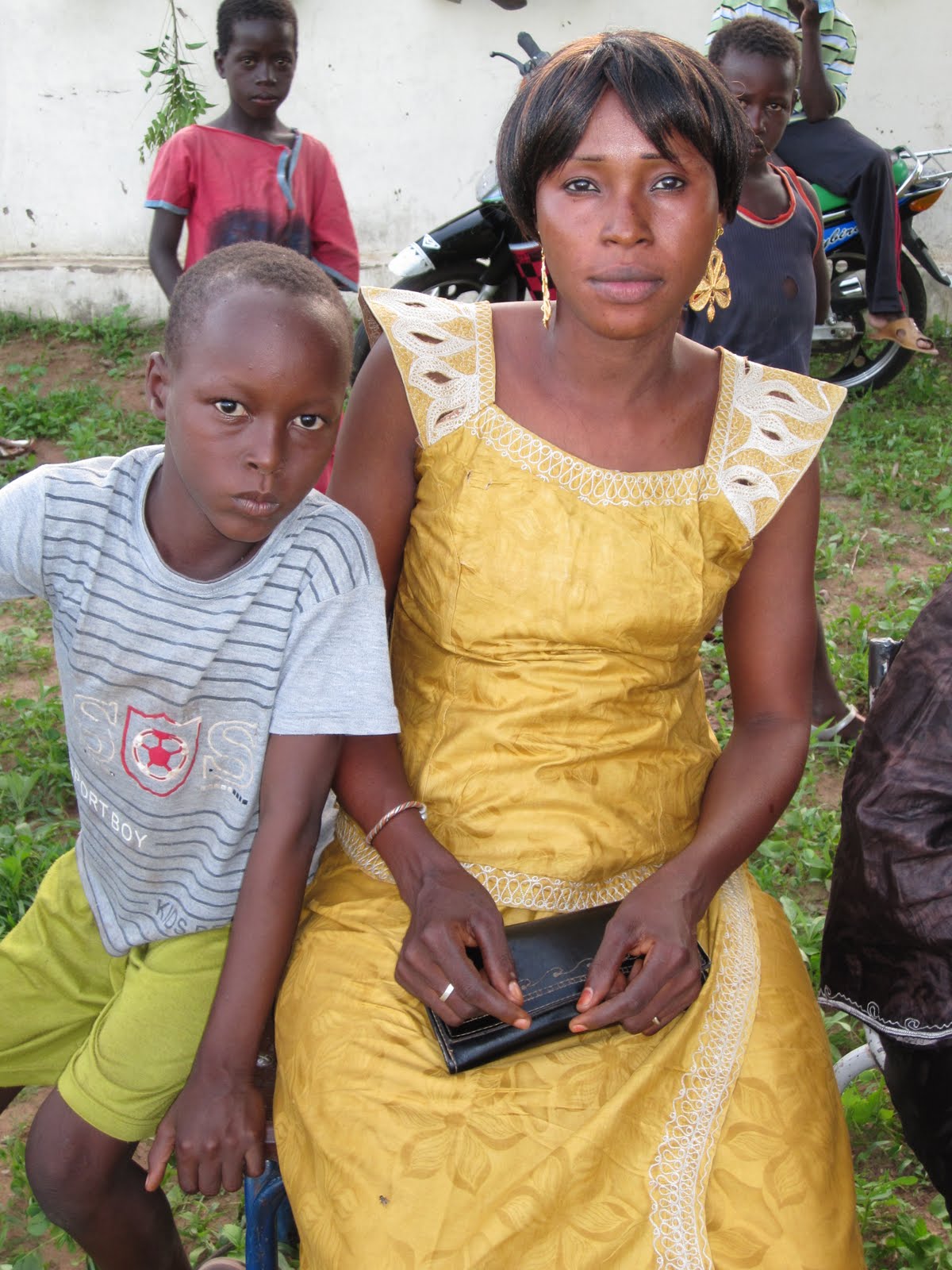
My good friend Oumou and her son Bu. All dressed up for the students vs. villagers soccer game. Oumou sponsored a big dance that was held the evening following the soccer game.
Here is the student side of the soccer game:

Ben and Kelly gave out lots of stickers to the kids in my village. Quite a hit, though it turned into kids trying to trick us into giving them more and more stickers. And, as we all know, stickers are meant to be put all over your face.

Ben and Kelly with one of their 3 chickens:

Papa, Ladji and Mamidou - my homologue's sons - plowing their field after one of the big rains in June.
Ben and Kelly's visit attracted more kids to my compound than are normally there. Kids I had never seen even showed up!

And, there were kids constantly standing in my doorway watching Ben and Kelly's every move (until I, ehem, politely, would tell them to get out of there).


Friday, June 4, 2010

Projects

It's been a long time, but no worries, everything is going well on this side of the planet. It has been a very busy month and a half filled with weddings and work-related activities. I have lots of ideas for blog posts now though! Keep your eyes out for a blog entry describing Malian weddings (at least how they are celebrated at my site).

Two quick notes before I get too far:

1. Check out the new Goodreads section on the right side of the blog. If for some reason you were interested in what I've been reading while in Mali, there you go!

2. We've been having problems at the post office recently...many of our packages have been opened and have had materials stolen from them before they reach Kita. If you send a package, please tape it such that it is difficult for me to open. I've also heard that writing Bible verses or religious symbols on the package can keep it from getting opened. Worth a try I guess.


Alright, what have I been doing the last month? I have completed my first true "project" as a Peace Corps Volunteer. At the beginning of May, I received small project assistance (SPA) funds from the Peace Corps to hold a training about the production of high quality shea butter at my site. While the logistics of the training (and getting straight answers from our trainers) were a bit of a pain to organize, the training seemed to be a success. 5 women and 1 man were invited from each of 4 different villages. With a few people added here and there, 31 people participated in the training. During the first day, the trainer discussed how to produce high quality shea butter starting with the gathering of nuts and ending with going to the market to sell shea butter. As I have mentioned in a previous blog post, if women are able to produce high quality shea butter, they are more likely to sell their product for a high price. They may even be able to sell their product in an international market. But, since international market standards are so high, shea butter must be produced following strict guidelines. Many of the practices we discussed are relatively simple, and do not require a big jump from how women in my village currently produce shea butter. This means that creating a high quality shea butter is well within the reach of the women producing shea at my site. Here is a picture of the women gathered together for the training:

Here is a picture of our trainer, Oumou, using pictures to describe good shea butter practices during the training:

During the second day of the formation, the women made shea butter following the practices they had learned the day before. Oumou closed the training by talking about how associations should be run, and how the women can improve their association. Many women remarked that they had learned a lot, and hoped we could hold similar trainings in the future.

As we enter the rainy season in Mali, shea fruit is beginning to ripen. I will be excited to see the women who attended the training implement the practices they learned. Here is several women making shea butter on day 2 of the training:


All of the women involved in the training gathered together:

The weekend following the shea training, Mama, a Peace Corps employee, came out from Bamako as part of our PC Food Security project. Mama helped my homologue (work partner) and I to conduct several meetings with both the Women's Association and Men's Animal Raiser's Associtaion at my site. We used a process called PACA, or Participatory Analysis for Community Action (see the Peace Corps PACA manual here). Rather than simply asking community members what they want, PACA begins with appreciative inquiry and community assessment activities. The idea is to encourage community members to recognize all of the resouces that they have in their community (health clinic, schools, mayor's office, water pumps, grinding machines, mosques, market, etc.) and to recognize that they are already participating in many work activities that they can be proud of (producing shea butter, selling meat, selling produce from the women's garden, etc.). Ideally, this would turn the focus of the meetings from "We need this, we need that, we have nothing, we have no money..." to "What resources can we use within our community to improve our situation, and what outside help would be most useful and most likely be successful in helping us to improve our livelihood?"

Here are several pictures of bott the men's and women's groups working on drawing a map of their community in the sand. They identified all of the major buildings and resources available to them within the village:


The meetings seemed very successful. Mama encouraged myself and my homologue to lead a large portion of the meetings, which instilled us with confidence that we can complete similar meetings on our own in the future. While I know these meetings were just the beginning of many conversations that will be had with these two groups in the community, we were able to identify initial project priorities for the two groups. The women would like help to improve the wells in their community garden (the wells currently collapse each rainy season, and most have dried up during the hot season). The animal raiser's would like help in starting a bank for animal fodder in the village. I will let you know how these projects proceed (or don't) in the future. These meetings were a great way for me to continue to understand my community. I wish that this could be available for every Peace Corps Volunteer, but earlier in their services (I'm almost 9 months in!). PACA is a great tool, though can be very intimidating during your first few months of service. With the help of a Malian PC employee who both understands the language and culture of my community, we were able to complete PACA much more successfully than I might have been able to do alone with my homologue.

Alright, I'm headed back to site, I'll try to write that entry about weddings during the next couple of weeks!

Tuesday, April 13, 2010

Shea and stuff

I hope everyone back at home is going well as the days get warmer and the flowers start popping up everywhere. It's also getting warmer here, and by that I mean hot. Each day is reaching at least 105 degrees, and even hotter on most days. There was a big rainstorm in Bamako on Friday night - the "Mango Rains." These rains arrive about this time of year, and help make the mango harvest especially delicious. I was told that after a week of rains, it will get really hot. At some point I wonder how much difference a few degrees will make - we are already sitting in our own sweat all day every day at this point. I'll let you all know when those extra few degrees arrive.

Life is going well in Mali. The moon is still here and still beautiful. March was a very busy month full of shea butter trainings in Bamako with my work partners, and planning the Kita Regional Training for all of the PCVs in the Kita area. Because of all that, I have hardly spent any time at site - which is very unfortunate at a time when I am trying to get projects started up. I will head to site this evening once the sun goes down a little, and I look forward to a long stay in my home.

I just returned from a 3 day training in Bamako about establishing a shea network between all of the small villages that PCVs work in, such that women will be able to sell their butter to a wider market. Most buyers want to buy large quantities, and it is difficult for small villages to produce such large amounts by themselves. We also discussed the importance of producing high quality shea butter. There are many steps along the shea butter production process that can intoduce contaminants, which can lead to a 250-500 CFA difference in price per kilo ($0.50 - 1.00, which is quite a huge difference when the price per kilo is generally between 500-1000 CFA depending on quality). The whole training was conducted in Bambara, and two women from my village attended it with me. They are so excited to get going on shea work now - it will be important to get together with the other members of the shea association to share what we have learned! To continue with the excitement, I am hoping to hold a training on how to produce high quality shea butter at my site in the next month. Ni Ala sonna, it will all come together, but I find that planning things in Mali is far more difficult than planning at home...things are often pushed off to the last minute, including informing people of WHEN the formation will be occurring! Hard to plan for that. Alas, dooni dooni (slowly, slowly).

Village life has been going well, despite not being around as much as I would like. My friend Oumou just had her baby (see a picture of her peeling woso in a previous post). His name is Madi Keita, and he was whiter than me for the first two weeks of his life! The wedding season has commenced in my village, and every weekend there is either an engagement party or wedding to attend. My work counterpart's two eldest sons are getting married this year, I am very excited for their weddings. Also, a member of my host family will be marrying his second wife in the next few weeks. All very exciting, and lots of celebration to lead up to the next rainy season and the start of the planting season.

My garden is doing okay, though suffering for my lack of attendance. I have hired a girl to water it for me when I am gone, which leads to more reliable watering than what I had before. The tomato harvest ended up going very well, and is slowing down quite a bit now. I ate the first green pepper from the garden just the other night, which was very exciting - this is a vegetable that I can rarely get in village. The most exciting bit about my garden is that I have started to use a new type of compost (I wish I could see your faces as you read this)...my pee! My plants have doubled in size in just a short amount of time after first adding the urine fertilizer, it seems to work VERY well! The Peace Corps held multiple trainings on using urine fertilizer during our trainings, and it took me until now to start using it. It's very easy, you fill a water jug with 5 L of water, then add 5 L of pee over the next few days. The jug must sit (tightly sealed) for at least 2 days to kill any schistosomiasis or other bad bugs in the pee (though it has been found there there isn't too much bad stuff going on in pee, just schisto if you are unlucky enough to have it). After two days, I take the jug to my garden and add another 10 L of water, and apply to the garden. Voila! A ma gelen (It's not hard). I am going to see how well it works on my garden, then do a short animation for the women in the garden talking about it. Urine fertilizer is a hard thing to accept, because it is, well, urine. From what I've read though, it has an even higher nutrient content than using straight cow manure...

See the entry just before this for a bunch of pictures from the last month, from village and around town. I celebrated Passover in Manantali with many volunteers, which was a lot of fun. I never expected to learn so much about Judaism in Mali! My PCV friends who are Jewish held a whole Sadyr dinner for all of us, and explained the significance of the holiday and the foods that we were eating, it was really great.

Take it easy until next time, go see some music and dance your butt off.

A life in pictures

I've got a lot of pictures from the last month and a half...enjoy!

Working with shea butter is going to be one of my main projects here in Mali. Here is a photo with my counterpart, Bintou, myself, and the President of the Women's Association, Djeneba. Bintou and Djeneba had just received their certificates for completing a 3-day shea butter training:


Last week, the Women's Shea Association made a whole bunch of shea butter. Here is a picture of 3 of the women "beating" the shea butter:


I've had trouble posting videos in the past, so we'll see if this works. Here are all of the women beating shea butter.


And, me, pretending I know what I'm doing for 10 minutes. Beating shea butter is a good arm workout:

After you first grind the shea nuts, the shea butter is a dark brown paste. You have to beat it with your hands for 1-2 hours to draw out the actual shea butter. After this time, it becomes a white color. So, here's the shea butter, almost done with the beating process.

Next, the white shea butter is boiled for quite a long time to draw out the actual shea butter:

And, then you get shea butter!


I visited a man in my village named Buwa the other day, who has a very large and successful garden. He has hundreds of banana trees. In this picture, the kids who work for him had cut down some of the bananas to sell to women in my village. The women then sell the bananas in the market, where I buy them and am very thankful that I can get fresh fruit in my village!

My friend Oumou gave birth a couple of weeks ago. The baptism was held one week after the birth of her son, his name is Madi Keita. I spent the morning of the baptism playing cards and games with the men. This game is called Lido, and reminds me a lot of Trouble. I did alright, I am pretty sure Adama, Damisi and Mogoba were making up some of the rules as we went...:


In late March, all of the volunteers in the Kita and Manantali areas got together with their counterparts for a regional training. It was a relatively successful training, I was happy just to get some one on one time with my work counterpart, without the distractions of her other work in village. Here's the group photo:

Here's the ladies from Kita region, we all got outfits made of the same fabric for the training.


Eating out of the communal bowl at lunchtime during training. Yum, tigadegena (rice with peanut butter sauce). This is Karmen, Lindsey, me and Ryan:


Another group at the communal bowl, Jess, Jackie, Joelle and John:

About a month ago we celebrated my 25th birthday in Kita with a delicious burrito dinner, tye dye shirt requirement, and a yummy birthday cake (frosting creatively colored by Jess using powdered juice packets):


We had a big party at my site with a married men vs. single men soccer match followed by a dance that night. Here's Oumou and I, resting for a few minutes before going back on the dance floor:


This is Damisi, my next door neighbor. He's just figuring out how to talk, and comes to greet me every morning and evening. Definitely one of my favorite kids in town.

We celebrated a Kuranajigi (spelling totally wrong I'm sure) in a nearby village. This was the celebration of a student of the Koran finishing reading the Koran. There was a big feast with lots of praying, chanting, and chatting. In this picture I am sitting with many of the women inside, preparing dege (kind of millet with sugar mushed into a ball, it tastes okay). The women were surprised to see that the Tubab could roll dough into a ball, I had to explain that we do it all of the time to make cookies...


As the dry season moves forward, I begin to understand more and more why Malians are scared of frogs. This is the drainage hole from my concession onto the street, where I dump my dish and cooking water. I went to do my dishes one night and found tons of frogs congregated in the pool of water! Add this to the many times I have dug up frogs (more like goo balls) 6 inches under the ground in my garden or in my compost pit...I assume they put themselves down there to save moisture during the hot season?

Again, I don't know if this video will come through, but we have some pretty amazing dancers in my village. Just watch those hips and feet move!

Friday, February 26, 2010

Cold Soda, Cold Pop

I guess it hasn't been too long since my last blog entry, but a lot has happened! I just returned from a trip to Senegal for the West African International Softball Tournament (WAIST), followed by a quick trip to the Gambia. Peace Corps and Expat teams from all over West Africa got together for a weekend of softball and parties. Unfortunately my team didn't make it to the semifinals, but we went 2-1-1 in the round robin games. Our team, the Cowboys, certainly didn't receive any help from my "awesome" softball skills! Here is a picture of the Seattle Kawboys...Holly, Gloria, me and Mike (Kaw means family in Bambara ):

Here is part of Kita Kaw after an awesome game of kickball, unfortunately won on the basis of rock-paper-scissors by the Refugees (a team made up of volunteers that worked in Guinea and Mauritania up until the programs in those countries were shut down), Ryan, Jess, Joelle and I:

Me, Joelle and Jess enjoying a view of the ocean on N'Gor island in Dakar, Senegal.


I traveled to the Gambia with three friends after the softball tournament. Highlights of the trip to the Gambia were swimming in the ocean, watching the catch of the day come in on pirogues (canoe-like boats that we were told travel from 10-20 km into the ocean to go fishing), going to a nature reserve filled with monkeys, having to pull a cable to bring a boat across the Gambia river, and the hospitality of all of the Gambia volunteers, especially our host Kris. Here's some pictures from the trip, first the small port where we watched all of the fish come in:


Taxis were being loaded with fish to go to the local restaurants. I got to eat lots of delicious fish in both Dakar and the Gambia.


After watching the fish come in, we had a small "senior photo shoot." This was my winning photo...:


Here's Ester and Jess, both of whom are also from Washington:


Matt, Jess, me and Owen on the beach. The four of us traveled together from Dakar, through the Gambia and back home to Mali. We were so happy to be back in Mali when we crossed the border!


The Gambia volunteers held a toga party for one of their volunteers who is leaving early to start medical school. All of the Mali volunteers who were in town decided to join in.


I'm on my way back to site in just a few hours where I will go to my homologue's son's engagement party, it should be a lot of fun. I spent January and February at site continuuing to learn Bambara, making new friends, and working on my garden. Sometimes I feel like my garden has been a series of failures, and there are two obvious problems with this. 1. Will I get any food for my hard work? and 2. How will the women in the garden ever trust my gardening advice? I'll blame most of my problems on the huge envrironmental differences between Mali and the places I have gardened in the past - Ecuador and Washington. Also, I haven't grown most of these vegetables before, so a lot of what I am doing is based on trial and error. Next year, ni alla sonna, I'll have an awesome garden.

So, what problems have I had? Worms and grasshoppers have become my arch-enemies. Grasshoppers have single handedly destroyed my carrot (x 2), cabbage, beet (x2), and salad (x2) peppinieres. I might have been able to halt the destruction had I caught it earlier, but by the time I had discovered the problem and brewed up some strong natural pest deterent (Neem tree, garlic, hot pepper, onion, and soap), the seedlings were all but gone. Sad times.

Worms are a more recent problem. I have about 90 tomato plants with a lot of fruit on them, which is very exciting. But, I have just discovered that worms have enterred most of my tomatoes...I am pretty sure they are some sort of moth larvae. Once they enter the tomatoes there is not much I can do, so I searched for the little green worms on the plants before I left for Senegal, and I couldn't find a single one. Shoot.

Yesterday, while visiting my site with my boss, Yacouba, we discovered that worms of a different kind have destroyed my green beans. When I left for Senegal, my green beans were robust and just starting to fruit. Yesterday, I was hoping to show my Yacouba my beautiful green beans. When we arrived at my garden, they were yellow, rotting skeletons of plants. Yacouba pulled up the plants and we discovered that worms had enterred the roots of the beans and destroyed them! Oh jeez. So much for all the delicous green beans I was hoping to harvest.

I've also had some transplanting issues, and discovered that the lettuce I was hoping to harvest right after my trip to Senegal has gone to seed during the two weeks I was gone. Now that I don't have any trips planned, hopefully I can do some good recovery work in my garden at get some produce from it. We're on the brink of hot season, and I am hoping the water in the wells will last for awhile longer. It was a really good year for rain, so I might be in luck. Here's some pictures from the garden before I left for Senegal:


Yum, lettuce, except the three largest heads went to seed in the last two weeks, which makes them very bitter and not nice to eat.


Here is one of my four beds of tomato plants. Can't wait to harvest these!

This was the first tomato fruit to appear. It has since been destroyed by worms.


Here are some more lettuce beds, they haven't gone to seed yet, so I should be able to eat and give away lots of this lettuce!


Onions, which appear to be growing well. Most of the women in the garden grow onions exclusively, and they all seem to be expert onion growers.


Lastly, here are some pictures from around my village. I should let my vegetarian friends know that there is an offensive picture coming up. First, this is my friend Oumou peeling woso (sweet potato). She will be giving birth sometime in the next 1 1/2 months.


Here is Gundo, Sayon and their kids. Gundo is one of my host moms and makes me lunch every day.

The day before I left for Senegal, there was a big party to celebrate the baptism of a baby named Mariama. As part of the celebration, two goats were killed. In the afternoon, I was chatting with some friends, and all of a sudden my host brothers started attacking each other playfully with the heads and legs of the goats. Shortly after this picture, the heads were cooked and eaten:

Take it easy until next time!